Slack Water, Happy Legs: Building a UK Estuary Walk Around the Tide
Most people plan a coastal walk around the distance, the forecast and the pub at the end. On an estuary, that order is wrong. The tide sets the schedule, the route and, if you ignore it, the pace of your last mile. Get the water right and the day becomes something rare in British outdoor life: unhurried.
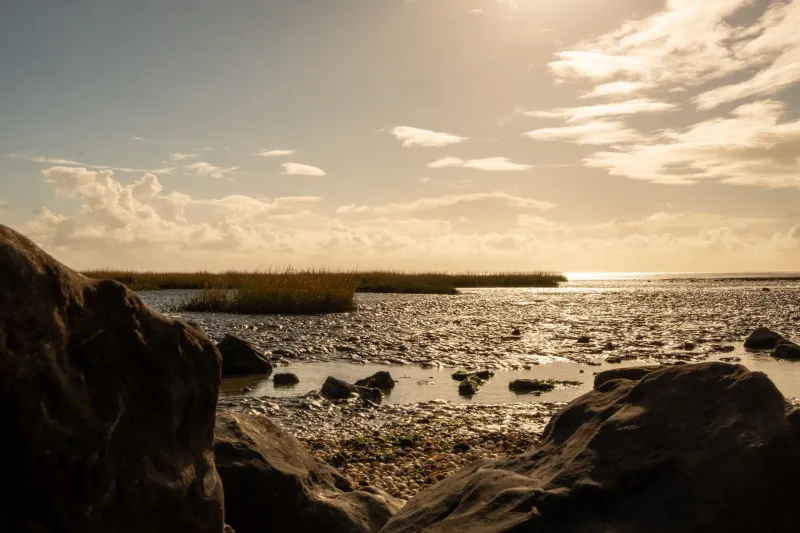
Estuaries are strange places. They look like beaches and behave like rivers. The water does not arrive politely from one direction — it fills from behind, creeps up creeks, and reappears across flats you crossed an hour ago. A route that reads as a straightforward there-and-back on the map can become a sprint against something you cannot outrun. Treat the tide table as the trip leader and everything else falls into place.
Read the water before you read the map
Start with the tide table for the nearest standard port, then adjust for where you will actually be. Tide times shift by minutes to well over an hour along a long estuary, and heights vary enormously between spring and neap tides. A nine-metre spring at the mouth of the Bristol Channel and a six-metre neap are not the same day out with different numbers; they are different trips.
Two things trip people up. First, chart datum: the heights in the table are measured from a low reference level, not from the seabed you will be standing on, so a 1.2m low water does not mean 1.2m of water under your boots. Second, the rule of twelfths. In a six-hour tide, roughly one twelfth of the water moves in the first hour, two in the second, three in the third, three in the fourth, then two, then one. The middle hours are the fast ones. Plan to be out on the flats early in the ebb, not late.
Wind and pressure matter too. A stiff onshore wind and a deep low can add height and bring the water in ahead of the published time. In the Bristol Channel and the Solway, a big Atlantic low has a habit of making the tide feel personal. Fog is the other quiet menace: it removes your view of the channel that is filling behind you.
Mud is not the only thing to worry about
Everyone warns about mud, and rightly — estuary mud can be thigh-deep, and it does not always look different from the firm stuff. But the bigger hazards are less dramatic. Channels fill before the main tide and cut off the route you came in on. Sea walls have ladders at intervals that never match where you need one. Cockle beds and old mussel beds are ankle-traps. Sand that held your weight at 10am can be slop by 1pm.
This is why guided crossings exist at places like Morecambe Bay, and why you should not treat a route description from five years ago as gospel. Sands shift. Check with the local harbour authority or a reputable guide before committing to any crossing of intertidal ground, and take local advice seriously when it says no.
Choose a route shape that suits the water
The easiest estuary day is a there-and-back with a hard turnaround time. Walk out on the ebb, set a fixed turn point — low water plus ninety minutes, say — and stick to it even if the pub is only twenty minutes further. The walk back is on a flooding tide, which is fine as long as you have left yourself the margin to be off the wet ground before it matters.
Point-to-point routes work where a causeway, bridge or ferry does the awkward bit for you. The Exe estuary trail from Topsham, the Mawddach Trail over Barmouth Bridge, and the seawall paths around Parkgate on the Dee all let you enjoy the water without bargaining with it. Loops along a sea wall or embankment are the safest option of all: you keep the estuary in view, you get the birds and the light, and you never have to test the mud.
Kit that copes with wet ground, not just rain
Estuary walking is less about waterproof shells and more about what happens underfoot and what happens when the day runs long.
- Footwear: trail shoes for firm sand and sea wall; something quick-draining and snug if you genuinely need to wade. Tall wellies are tempting and usually a mistake — they fill, they drag, and they offer no grip on slick mud.
- Poles: one or two, for balance and for prodding the ground ahead before you commit your weight.
- Navigation: a paper map in a case, a compass, and tide times on paper as well as on your phone. Batteries die; the tide does not.
- Spares: a dry bag with a warm layer, hat, gloves, headtorch and spare socks. A flask. A towel in the car is the best tenner you will spend.
- Summer extras: sun cream and midge repellent. Estuaries are insect factories in still, warm weather.
Build in a buffer, then relax
Work backwards from high water. Decide when you need to be off the wet ground, subtract an hour for the unexpected, and only then choose your route. Tell someone where you are going and when you will turn around. If the water arrives early — and it can — you will have minutes, not hours, in some channels.
Do this properly and the estuary gives you something the hills rarely do: a day with slack in it. Time to sit on a sandbank and watch wading birds work the falling water. Time for a second coffee. Time to notice that the channel you crossed this morning is now a river running the other way. The tide is the timetable, but it is a generous one if you read it first.