The Four-Hour Rule: Winter Hill Days That Still Feel Like Days Out
November and December 2026 bring the sort of hill days where the sun clocks off before the afternoon has really got going. In much of the UK, sunset sits somewhere around 15:45, and in the Highlands it can be earlier still. That doesn't mean the hills are closed, or that every outing needs to become a dawn raid. It does mean the planning has to change.
The trick is not to pretend it's still summer. It's to build a day that works with four or five hours of usable light, rather than one that quietly assumes you'll be back at the car before the shadows get long. Get that right, and a winter hill day can feel like a proper day out rather than a rushed errand.
Start with the sunset, then work backwards
Pick your objective, then find the sunset time for the date and location. Not the sunset for your kitchen window: the one for the hill. Subtract a generous buffer — 90 minutes is a good starting point in winter — and then subtract your estimated walking time. What's left is your latest sensible start.
That calculation often changes the plan. A big ridge that felt fine in June may need to become a shorter circuit, a lower summit or a there-and-back with a firm turnaround time. That's not defeat. It's choosing a route that fits the day you've actually got.
Add time for the realities of winter walking: boggy ground, slippery rock, extra layers, a brew stop, and the fact that everyone moves a bit slower when the wind is doing its worst. If your schedule only works when everything goes perfectly, it doesn't really work.
Build in an exit before you need one
A good winter route has escape routes. Look for valley paths, forest tracks, landrover tracks and straightforward descents that let you cut the day short without a drama. Mark them on the map. If you're using a GPS app, don't rely on it alone — carry a paper map and compass, and know how to use them when the screen is cold and your fingers aren't cooperating.
Set a turnaround time as well as a start time. Write it down. Tell someone. If you haven't reached the summit by then, you turn around. That's not being overly cautious; it's how you avoid the last hour of the day becoming a negotiation with fading light.
The headtorch is not a failure
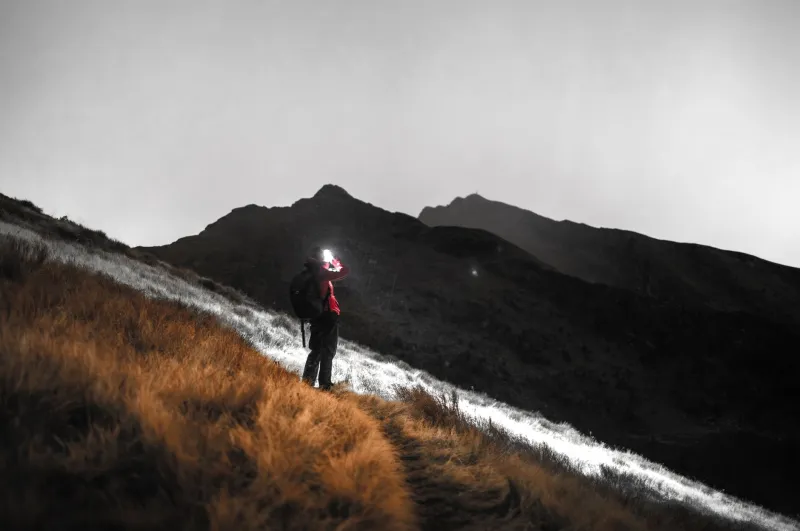
There's a strange idea that needing a headtorch means you've got the planning wrong. Not true. A headtorch is just another piece of kit, like a waterproof or a map. The important thing is that it's in your pack, it works, and you know where it is before you need it.
Carry a primary headtorch and a small spare. Fresh batteries in both. Practise switching it on with gloves. Keep it somewhere accessible rather than buried at the bottom of your pack under a flask and a spare fleece. If you're still walking at 15:30 in December, put the headtorch on before you strictly need it. Your eyes will thank you, and so will your ankles.
Headtorch discipline also means being honest about the route. A simple forest track in the dark is one thing. A pathless hillside with crags and a tricky descent is another. If the plan includes any chance of finishing after dark, choose ground that behaves itself when you can only see a cone of it.
Kit that actually matters
Winter hill days don't need a mountain of gear, but they do need the right gear. A warm layer that stays dry, a spare insulation layer, gloves and a hat, a waterproof shell, food you'll actually eat and a flask of something hot. An emergency shelter and a small power bank are easy to justify when the daylight is short and the temperature drops quickly.
If there's snow or ice on the ground, carry the right traction and know how to use it. Don't assume a winter hill day means crampons and axes; plenty of UK routes are just cold, wet and windy. But do check conditions, read recent reports and be willing to change the objective if the hill says no.
Make the short day feel full
A winter day out doesn't have to be a race. Start early enough to enjoy the first proper light, stop for second breakfast, take the photo, have the brew. A shorter route done well often feels more satisfying than a long one done in a hurry.
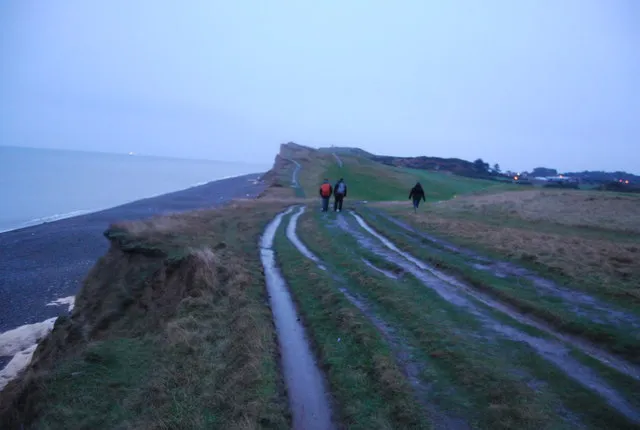
Finishing in the dark isn't a disaster either, provided it's planned. A headtorch walk back to the car, followed by a pub or a cafe, can be a genuinely good end to the day. The point is that it's a choice, not a surprise.
So use the four-hour rule, or whatever version of it suits your pace and your hill. Pick a route that fits the light. Carry a headtorch you trust. Keep an exit in your back pocket. Then get out and enjoy the short, sharp, quiet version of the hills that only winter offers.