The Bottle-and-Beck Plan: Carrying Less Water on British Hills
Somewhere in the outdoor collective imagination, a three-litre bladder has become the default badge of a serious hill day. Fill it at the car park, hoist the pack, and off you go. The trouble is that three litres weighs three kilos, and on plenty of British routes it is answering a question nobody asked. Water is not a fixed kit-list item. It is a moving part of the plan.
Start with the route, not the bladder
A short winter circuit in the Cheviots and a long summer traverse across a dry, exposed ridge are not the same problem. Neither is a boggy trudge through the Pennines and a fast, light pack on the South Downs. Your water carry should reflect the day you are actually having: distance, ascent, forecast, pace, shade, exposure and how often you can realistically refill.
On a cool November day, many walkers will get round a half-day hill route on a litre or so, topped up at a tap or a stream. On a hot June afternoon, with 900 metres of ascent and a group moving slowly, the same person might need far more. The point is not to memorise a number. It is to stop treating three litres as a moral standard.
What ‘enough’ looks like in practice
Hydration needs vary wildly. Body size, fitness, acclimatisation, clothing, effort and how much you drank before leaving the house all matter. A rough working range for moderate British hill walking is often somewhere around 400–600ml per hour in cool conditions, rising in heat, strong sun or sustained climbing. But that is a starting point, not a prescription.
A better approach is to plan in blocks. Ask yourself where the next reliable refill is, how long you will be between those points, and what the weather is doing. If the answer is ‘four hours on an exposed ridge with no water’, carry for that block. If the answer is ‘90 minutes to a café and then a beck halfway round’, carrying three litres from the start is just extra work.
The refill map: where water hides on British routes
British hill days are often wetter underfoot than they are generous with drinking water. That said, refill points are more common than many walkers assume. The trick is to identify them before you set off rather than hoping for the best.
Start with the map. Streams, becks, wells, springs and public taps are marked on Ordnance Survey and Harvey maps. Guidebooks and local authority websites sometimes list village taps, visitor centre water points and café refills. Railway stations, pubs, campsites and bothies can also be useful, though you should never assume a business will fill your bottle for free — ask politely and buy something if you can.
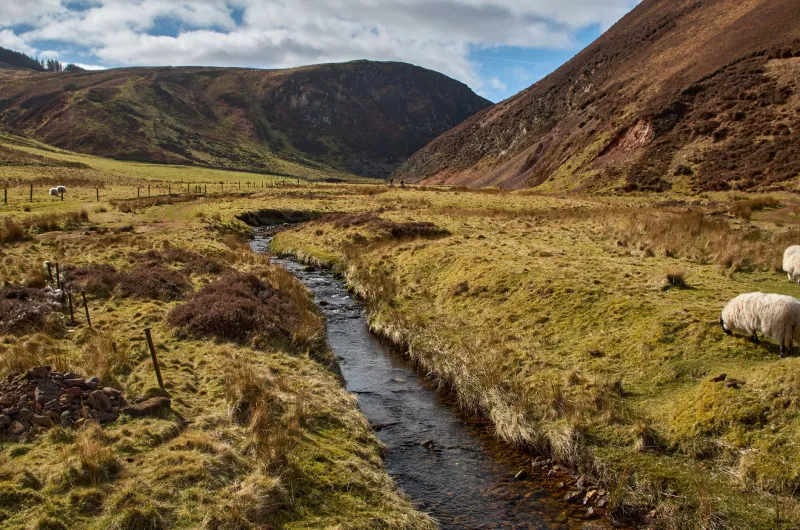
Then think about reliability. A blue line on the map is not a guarantee. Small upland streams can dry out in a dry spell, and lowland ditches are best avoided. In sheep country, assume surface water needs treatment. If you are unsure about the source, filter it and have a backup method such as purification tablets or the means to boil water. A filter is not a magic wand, but it is a useful tool when used sensibly.
When a filter beats a bladder
A one-litre bottle and a lightweight filter — think 60–100g for a squeeze-style model — can be a far more flexible setup than a heavy bladder. You drink what you need, refill when you meet good water, and carry less weight uphill. You can also see how much you have left, which sounds trivial until you have spent an hour wondering whether the bladder is half full or merely sloshing.
A filter makes most sense on routes with frequent clean-looking refills: long Scottish glen walks, Lake District valley circuits, Welsh reservoir rounds and many all-day routes where streams are marked and flowing. It is also handy for bothy weekends and wild camps, where you may want water for cooking as well as drinking.
A bladder still has its place. It is excellent on dry ridges, in races or fast walks where stopping is a nuisance, and in cold conditions when you want to sip without exposing your hands. Just do not let it become the only tool in the box. In freezing weather, a bladder tube can ice up; a wide-mouth bottle is easier to manage and harder to lose track of.
The false comfort of ‘just carry more’
Carrying extra water feels responsible. Sometimes it is. But it can also become a substitute for thinking. A heavy pack makes every climb harder, which can make you drink more, which makes the pack heavier. It can encourage a sort of passive approach: no need to check the map for refills, no need to pace the day, no need to ask whether the forecast has changed.
There is also a practical limit. On a steep British ascent, an extra two litres is two kilograms of dead weight. That is roughly the difference between a lightweight shell and a proper winter jacket. If you are carrying it ‘just in case’ on a route with three reliable refills, you are paying for insurance you probably do not need.
A simple water plan for a British hill day
First, check the route: length, ascent, exposure and likely pace. Second, mark possible refills on the map and note any definite ones — a village tap, a café, a bothy tap. Third, check the forecast and factor in temperature, wind and sun. Fourth, choose a carry that covers the longest gap between refills, plus a small margin.
For many UK hill days, a one-litre bottle, a 500ml soft flask and a lightweight filter is a sensible starting point. Add a second bottle for dry routes or hot weather. In winter, keep at least one bottle accessible and consider an insulated sleeve. Carry purification tablets as a backup if you are relying on surface water. And tell someone your plan, especially if you are heading out alone.
The three-litre bladder is not the enemy. It is simply one option among several. The better question is not ‘how much water should I carry?’ but ‘where will I drink, and what is the lightest sensible way to get from one refill to the next?’ Answer that, and you will usually carry less, move better and still finish the day properly hydrated.